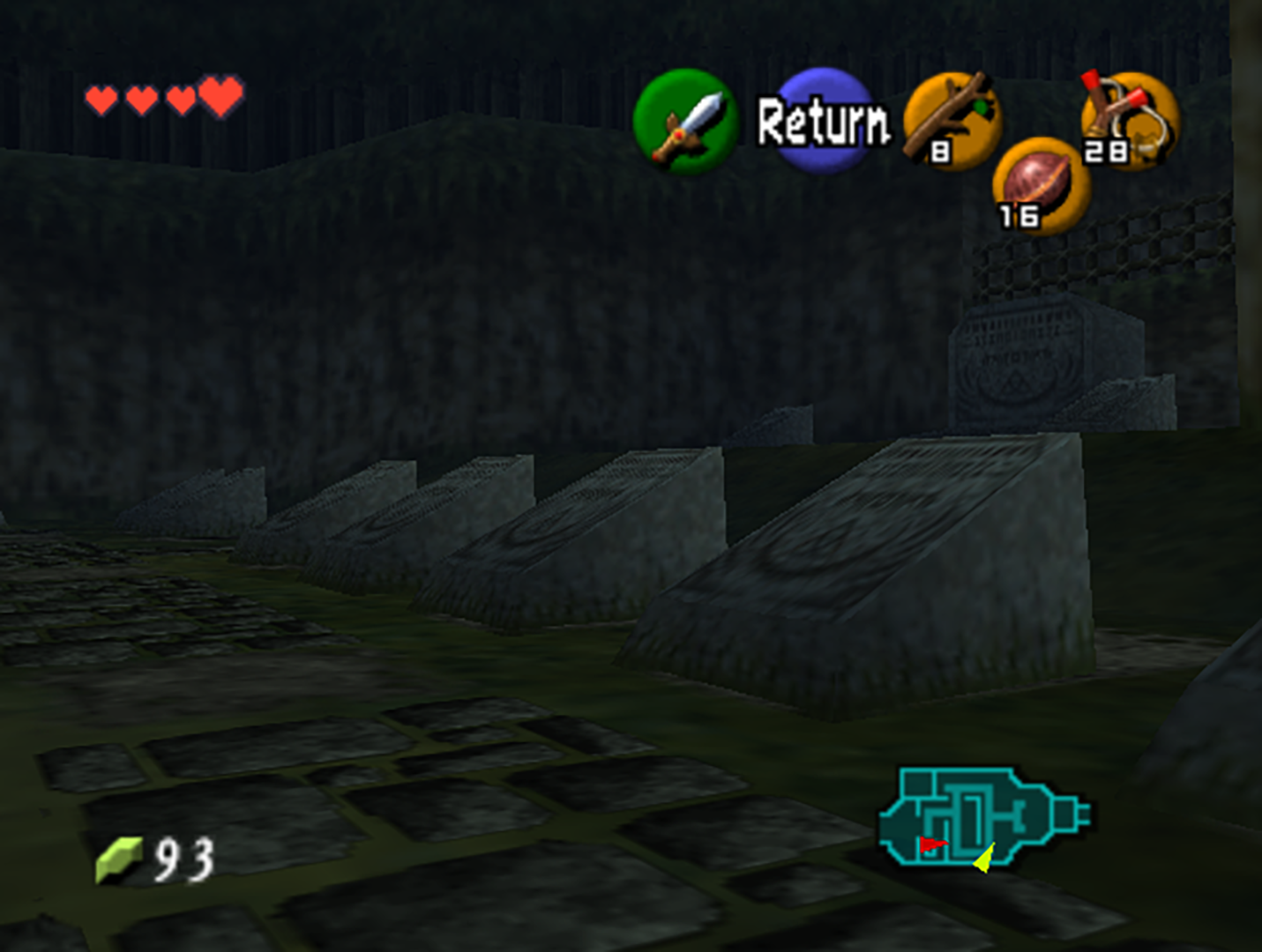
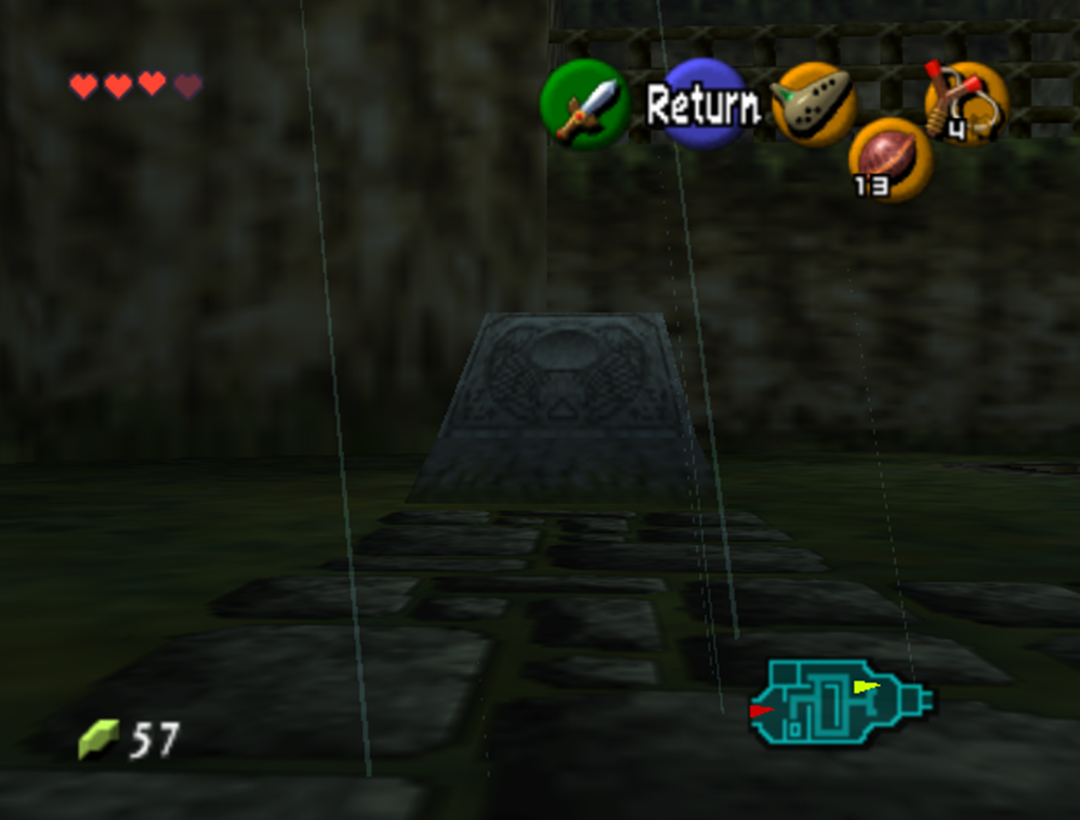
Entrance to the graveyard in the outskirts of Kakariko Village





| The Legend of Zelda: Ocarina of Time | |
|---|---|
| Game Information |
| Country of Origin | Japan |
| Original Title | ゼルダの伝説 時のオカリナ (Zeruda no Densetsu: Toki no Okarina) | Translated Title | The Legend of Zelda: Ocarina of Time |
| Development Information | |
| Developer | Nintendo |
| Director | Toru Osawa Yoichi Yamada Eiji Aonuma Yoshiaki Koizumi Toshio Iwawaki |
| Producer | Shigeru Miyamoto |
| Artist | Yoshiaki Koizumi Yusuke Nakano |
| Release Information | |
| Release Dates |
|
GAME INFO: The Legend of Zelda: Ocarina of Time is the first three-dimensional entry into the Legend of Zelda series, using the Nintendo 64's technological improvements to add depth of gameplay as well as an increased attention to dialogue, storytelling, and interactions between the player and various denizens of Hyrule. Players once again control Link, this time beginning the game as a child and eventually traversing time in order to prevent Ganondorf from acquiring all three Triforces and subsequently destroying Hyrule.
SETTING: Although this game also takes place in Hyrule, it is an altogether different representation when compared to Hyrule in the previous games, both geographically and in terms of its occupants. Numerous new races and cultures were added, many of which continued to appear in subsequent games, while previously recurring characters and enemies faced visual and conceptual revisions that differed wildly from previous incarnations. However, the setting of Hyrule retains its pseudo-European high-fantasy aesthetics, with medieval-level technology and supernatural elements that only suggest correlations to real-world mythologies.
FUNERARY IMAGERY: Like the previous games in the series, The Legend of Zelda: Ocarina of Time contains a single graveyard level located on the outskirts of Kakariko Village, right before Link ascends Death Mountain. The graveyard is small and composed primarily of unique gravestones that appear plinth-like, horizontal grave slabs that rise up toward their farthest point to face the player at an angle. The faces of these grave slabs are engraved with illegible epitaphs and an image of a Triforce partially encapsulated in a semi-circle whose opening faces upward. Only one grave slab in the entire graveyard contains flowers above which butterflies flutter. Two large upright gravestones appear in the graveyard, one at its entrance and one at the very end. The farthest such gravestone acts as a monument to the royal family of Hyrule, and is flanked by two smaller grave slabs commemorating royal composer brothers, Sharp the Older and Flat the Younger. When Link interacts with either of these two grave slabs, the respective ghost manifests and attacks him, eventually apologizing if Link manages to defeat them. They mention the presence of a song with magical capacities over which Ganondorf had them murdered, but they sequestered it in an area he cannot access. This happens to be the crypt located beneath the royal family's tombstone, which explodes after Link performs Zelda's lullaby on his ocarina. A hole leads into the subterannean crypt, which contains an entrance chamber populated by human remains and bat-like creatures known as keese, a second poison-filled chamber wherein frightening re-dead enemies lurk, and finally a monument to the royal family upon which the Sun's Song is engraved. If you enter the graveyard at night, you can encounter the gravekeeper Dampé, who will unearth the nearest grave for 10 rupees. During the day, Dampé stays locked in his shed on the graveyard grounds while a small boy who admires him stomps around the grounds.
ANALYSIS: The Legend of Zelda: Ocarina of Time both maintains and embellishes upon the precedent established by previous games wherein the graveyard acts as a mysterious area with equal propensity for hidden danger and hidden treasure. Touching two specific gravestones summons hostile ghosts, which have been renamed Poes in this game contrasting the Ghinis that appeared in previous games. Also, interacting with specific gravestones leads to a subterannean area housing a secret game mechanic that, while not mandatory, offers significant gameplay benefits by being able to alter the time of day at will. However, the graveyard experiences a visual overhaul that distances it from the Christian iconography used in The Legend of Zelda and Zelda II: The Adventure of Link by replacing the image of the cross with that of the Triforce. Similarly, the design of common gravestones also removes much of the Western European associations from the upright tombstones in previous games, of which there are only two enormous ones in this game that appear more as monuments to collective groups of people than individual tombstones. This redesign is just one element that establishes Hyrule as a unique world with fewer distinct attachments to any real iconographies or artistic traditions. Essentially, The Legend of Zelda: Ocarina of Time pushes the series away from pseudo-medievalism into its own unique fantasy expression.