
Graveyard in Western Hyrule





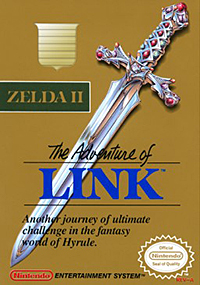
| Zelda II: The Adventure of Link | |
|---|---|
| Game Information |
| Country of Origin | Japan |
| Original Title | リンクの冒険 (Rinku no Bōken) | Translated Title | The Book of Link |
| Development Information | |
| Developer | Nintendo |
| Director | Tadashi Sugiyama Yasuhisa Yamamura |
| Producer | Shigeru Miyamoto |
| Designer | Kazunobu Shimizu |
| Release Information | |
| Platforms |
|
GAME INFO: Zelda II: The Adventure of Link is a direct sequel to The Legend of Zelda, taking place after Ganon's defeat at the hands of Link. However, Link's triumph proved to be short-lived, as Ganon's influence lingered in Hyrule, causing monsters to continually terrorize Hyrule for years following Ganon's downfall. One day, a mysterious symbol appears on Link's hand, prompting Impa, the royal nursemaid, to reveal the resting place of the original Princess Zelda, who, refusing to divulge the Triforce's whereabouts to a corrupt court magician, was stricken comatose forever after. Following the prophecy induced by the symbol on his hand, Link becomes the only hero in Hyrule who can use the Triforce to restore consciousness to the sleeping princess. Unlike The Legend of Zelda, the action sequences are side-scrolling and the visuals are much larger, allowing for better detailed sprites and backgrounds.
SETTING: Like its predecessor, this game takes place in Hyrule except in a much broader area that surrounds the initial map from The Legend of Zelda. Because of this, Link is able to explore a much larger area of the world, including towns that were not present in the first game. While the game introduces new gameplay mechanics, the most important of which is the ability to use magic, it does not introduce many new landscapes (marshes being an exception), rather re-interpreting the same environments of the first game with more intricate detail.
FUNERARY IMAGERY: The graveyard level returns with a vengeance in Zelda II: Link's Adventure, and features many of the same qualities of its predecessor, namely its locations within intermediately difficult areas of the game, its inclusion of upright headstones, and harboring secrets that are difficult to uncover. There are three graveyards in the extended map of Hyrule, and all three distinguish themselves from other environments on the overworld map by appearing as fields of upright crucifixes on a barren plain. The first graveyard that most players will encounter is southwest of the port town of Mido in North Western Hyrule, which has an isolated crucifix at its center that leads to the King's Tomb. Here, Link can uncover a secret underground route that is located south of king's Tomb, which will lead to the otherwise inaccessible Island Palace in the center of the ocean. Two other smaller graveyards can be found, one of which is south of Death Mountain and is implied to be the same graveyard from the first game, while the other graveyard in Eastern Hyrule leads to the final area, the Valley of Death. Link can move freely through graveyards on the overworld map, but is drawn into a side-scrolling stage when he comes into contact with an enemy sprite. The graveyard levels are just as barren as their overworld appearance suggests, consisting of rocky green terrain against dotted with upright grey headstones and white cross monuments against a purple sky. Like those of its predecessor, the headstones have small crosses engraved upon them with the addition of two lines of pixels that suggest graven epitaphs. Some of the cross monuments are upright while some are leaning over, seemingly about to fall. The King's Tomb is a single headstone engraved with a cross and epitaph upon a pedastal, wupon which two serpentine s-shaped statues flank the headstone. Pillars topped with totemic, monstrous visages stand at each end of the area, and an old woman in purple stands beside the grave, informing Link that he has reached the King's Tomb. The color scheme at the King's Tomb is softer than the other graveyards, with turquoise sands, teal monuments, and a soft blue sky. While the King's Tomb is devoid of enemies, other graveyards are plagued by ghost-like Moas that resemble floating eyeballs. Unless Link has found the cross in the Tree-Eyed Rock Palace, he will not be able to see the Moas that fly throughout the graveyard near Death Valley, although they can certainly see him and will attack. Similarly, the ruins of Old Kasuto Town located just southeast of the final graveyard are haunted by invisible Moas, rendering the town a de facto graveyard. Additionally, a small graveyard is located inside Saria Town toward the west exit, consisting of several upright crosses on an island connected by two small bridges.
ANALYSIS: The presence of three graveyard areas is Zelda II: The Adventure of Link directly references the quadrant of graveyards in the game's predecessor, The Legend of Zelda, albeit reconfigured to suit the dualistic nature of gameplay that switches between top-down overworld exploration and side-scrolling combat. Unlike the first game, whose map was an interconnected landscape, Zelda II: The Adventure of Link has an expansive overworld map that eclipses the first game's map in size to the point where the entirety of the original game is implied to have taken place in the southwest corner of this game's map, which is indicated by a small quadrant of graveyards in the same general location as those found in the first game. Otherwise, the overworld map is separated into Western and Eastern Hyrule, and each continent has a dedicated graveyard where, presumably, the inhabitants are taken to be buried. The exception to this phenomenon occurs in Saria Town, which has a small graveyard inside the town walls. Curiously, Saria Town contains creatures called Eyes of Gannon, which take the form of ordinary villagers who transform into a bat when spoken to. Similarly, Old Kasuto Town is entirely deserted except for one old sage and a legion of invisible Moas who haunt the crumbling ruins of the town. Both Saria Town and Old Kasuto Town are near graveyards, with Saria Town containing a graveyard while Old Kasuto Town has become one in the absence of life. The manifestation of enemies in close proximity to the dead imply that a somehwat corrupting influence exudes from the grave, which tacitly explains why each continent of Hyrule has a designated area that, with the exception of Old Kasuto Town, is located a healthy distance from settlements. Moreover, in keeping with the secretive, magical nature of the graveyard in The Legend of Zelda, the first graveyard level in Zelda 2: The Adventures of Link contains a secret entrance to a dungeon that the player is required to complete in order to finish the game. Similarly, an extra life is hidden in a bare patch of plains southwest of the first graveyard, which players would not be able to locate without exploring each section of the map in that area. Ultimately, the graveyards in Zelda 2: The Adventures of Link help establish the nature of such environments in the series, where the dead harangue the living who are bold enough to disturb them, with the potential to discover hidden features and progress the game.