
The graveyard area and its immediate surroundings





| The Legend of Zelda | |
|---|---|
| Game Information |
| Country of Origin | Japan |
| Original Title | ゼルダの伝説 (Zeruda no Densetsu) | Translated Title | The Legend of Zelda |
| Development Information | |
| Developer | Nintendo |
| Director | Shigeru Miyamoto Takashi Tezuka |
| Producer / Designer | Shigeru Miyamoto |
| Release Information | |
| Platforms |
|
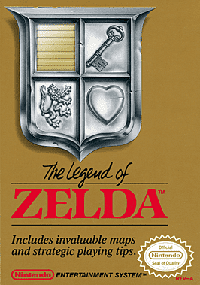
GAME INFO: The Legend of Zelda is one of the earliest games for the Nintendo Entertainment System and helped establish Nintendo's longevity through the game's popularity in addition to helping to define the fantasy genre in video gaming after its release. The game centers on an elf-like hero named Link who is tasked with rescuing Princess Zelda from the grips of the evil thief Ganon, who having stolen the Triforce of Power was preparing to acquire the Triforce of Wisdom before Zelda shattered it and hid the fragments throughout the land of Hyrule. Guiding Link throughout the treacherous landscapes of Hyrule, players acquire weapons and equipment as they re-assemble the Triforce of Wisdom, eventually confronting Ganon in his seclusion deep beneath Death Mountain.
SETTING: The game takes place in the purely imaginary realm of Hyrule that, while not overtly medieval European in origin, loosely relates to high-fantasy settings that feature similar technological levels and supernatural phenomena, such as J.R.R. Tolkein's Lord of the Rings, Ursula K. Le Guin's Earthsea series, and Anne McCaffrey's Dragonriders of Pern series to name only a scant few examples. As such, Link has access to such weaponry as swords, bows and arrows, boomerangs, and bombs, while his opponents are fantasy creatures ranging from goblin-like creatures, land octopi, ghosts, and half-human half-lion hybrids to list only a few, with his final foe Ganon taking the form of a giant anthropomorphic pig who wields lethal sorcery. All of these creatures are of unique origin, designed exclusively for this game with little-to-no reference to Japanese or European mythologies and folklore. Hyrule itself consists of a wide range of environments including labyrinthine forests, coastlines, mountains, deserts, and subterannean dungeons.
FUNERARY IMAGERY: One of Hyrule's environments is an expansive graveyard that occupiues six tiles on the north-eastern edge of the overworld map. Unlike the rest of Hyrule's warm and earthy overworld, the graveyard is a dismal grey landscape surrounded by ashen white mountains. Twelve upright headstones appear in each screen, also white but marked with a blue crucifix. Each screen contains a wandering ghost referred to as a Ghini, which is a somewhat challenging foe when attacked with early-game equipment. When Link touches a headstone, whether accidentally or intentionally, even more Ghinis emerge to assail him. These subsequent Ghinis are completely invulnerable, and will emerge continuously if Link keeps touching headstones. The only way to defeat the Ghinis is to destroy the first one that was already present in the area, which is further challenging since all Ghinis look exactly the same. Players are incentivized to reach the graveyard due to the presence of the Magical Sword beneath a specific tombstone, but Link can only use the Magical Sword after collecting twelve heart containers and thus increasing the amount of damage he can take. If players who complete the game play its second quest, the graveyard instead houses the entrance to the sixth dungeon beneath a headstone.
ANALYSIS: The first entry in Nintendo's long-running Legend of Zelda series establishes a generalized way in which graveyards would appear and operate in its numerous sequels throughout the decades. First and foremost, the presence of upright headstones lends the game a Western European flavor despite the fact that Hyrule has no distinct historical reference, instead being a video game cognate of literary high-fantasy developed and designed in Japan. Cemeteries feature in nearly all subsequent entries of the series, almost always retaining the form of upright headstones while largely abandoning the image of the cross, which in-and-of itself bears certain strange connotations. Since Hyrule was created with unique landscapes, creatures, and supernatural concepts without referencing the real world, the presence of Christian iconography in the form of a cross is a conceptual conflict. At this point in the lifespan of the series, The Legend of Zelda does not establish a theology. Consequently, the cross implies the presence of Christian faith simply by appearing in the context of Hyrule's funerary art. When Nintendo released The Legend of Zelda: A Link to the Past for the Super Nintendo Entertainment System in 1991, they portrayed Link praying in a church to a monument of Jesus Christ affixed to the cross, which is covered in more detail in that game's analysis. Nonetheless, it potentially affects the subtext of this game considering that The Legend of Zelda: A Link to the Past is a reiteration of the same story that takes advantage of the Super Nintendo Entertainment System's technological improvements. Intriguingly, neither entry refers to Christianity explicitly in-game.
In terms of game mechanics, the graveyard establishes a specific level of difficulty in the series that makes curious use of Western concepts of death and resurrection. The fact that the graveyard contains the Magical Sword, an intermediate upgrade to Link's weapon, suggests that the area is meant for players who have progressed to a certain point in order to have better chances at surviving the ordeal. It also establishes the graveyard as a supernatural environment, possibly lending the Magical Sword its namesake quality simply by existing therein. Reaching the graveyard is a fairly challenging task early in the game, as Link faces foes that are increasingly difficult to kill as he nears the graveyard. Moreover, the Ghini themselves are immortal with the exception of one per screen, whose death dismisses all other Ghinis on the same screen. The graveyard is clearly a special place where the laws of nature are twisted in some way. Here, death and dying affect the living as usual, but the dead themselves persist in a state where they are further removed from it compared to Link and the other denizens of Hyrule. When Link touches a headstone, the mnemonic agency of the gravestone as a commemorative monument is transformed into something treacherous, thus changing the act of grieving into a mortal threat. The Ghinis, resembling the classic image of ghosts bound in the winding sheets they were buried in, effectively symbolize the haunting aspects of remembering the deceased while also establishing a mode in which ghosts behave as gameplay elements throughout the series. The graveyard, as an environment where the dead are meant to be remembered, allows the game developers to explore death, memory, and grief in a very basic way at this very early stage of the history of video gaming.