Graveyard east of the church in Hyrule





| The Legend of Zelda: A Link to the Past | |
|---|---|
| Game Information |
| Country of Origin | Japan |
| Original Title | ゼルダの伝説 神々のトライフォース (Zeruda no Densetsu Kamigami no Toraifōsu) | Translated Title | The Legend of Zelda: Triforce of the Gods |
| Development Information | |
| Developer | Nintendo |
| Director | Takashi Tezuka |
| Producer | Shigeru Miyamoto |
| Artist | Masanao Arimoto Tsuyoshi Watanabe |
| Release Information | |
| Platforms |
|
GAME INFO: The Legend of Zelda: A Link to the Past is the third entry in The Legend of Zelda series, and one of the first wave of games released for the Super Nintendo Entertainment System. Players control the character Link, who explores Hyrula, a high-fantasy landscape, in an attempt to save the eponymous princess Zelda from the treacherous sorcerer Agahnim, who is trying to imprison seven descendents of ancient sages in an attempt to liberate Ganon from his own incarceration in the Dark World. When Link fails to prevent Agahnim from sending Zelda into the Dark World, he must walk between the two worlds to prevent Ganon's return. The game is essentially a reboot of the first game for the Nintendo Entertainment System with significant updates to its visuals, narrative, and gameplay, and the action follows the same top-down viewpoint.
SETTING: In keeping with the other games in the series, The Legend of Zelda: A Link to the Past takes place in a high-fantasy setting reminiscent of Medieval Europe, replete with medieval-era technology such as armored knights, melee weapons, and archery, as well as magical elements including, spellcasting, healing potions, and numerous magical items that allow the player to perform preternatural abilities. Players access specific areas such as castles, dungeons, towers, towns, and various landscapes randing from marshes to deserts from an overworld map that inverts when Link enters the Dark World, encouraging exploration without forcing players to take specific routes to complete the game.
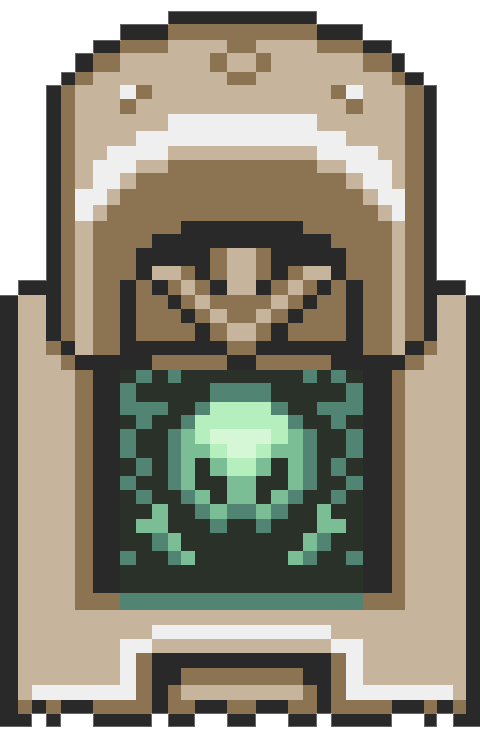
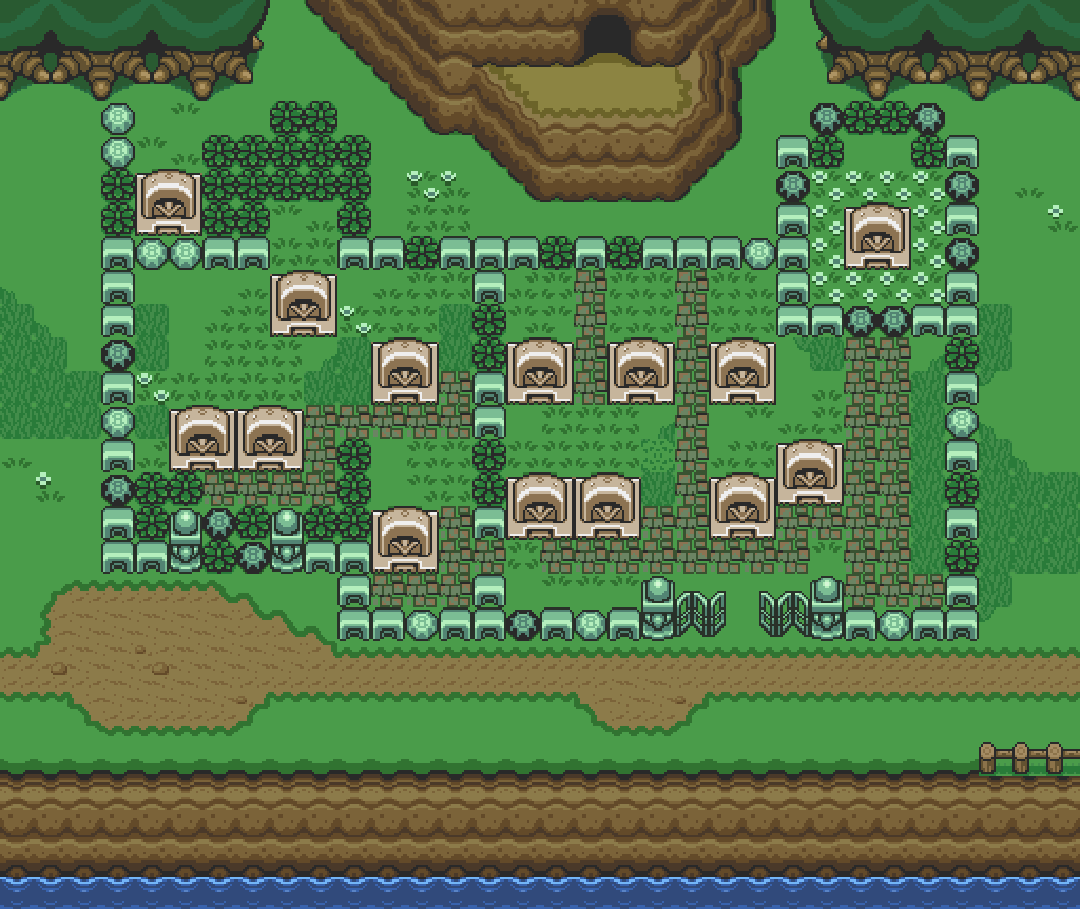
FUNERARY IMAGERY: Hyrule Cemetery can be found one block directly east of the Sanctuary located in the north of the map, populated with thick, upright headstones hewn from warm-grey stone. Unlike the crosses that are found on the tombstones in previous games, these headstones are engraved with an abstract design resembling the letter V with an oval-shaped design in its center, possibly evoking a human face flanked by angelic wings. If Link pushes a headstone with sustained force, he will invariably uncover a patch of human remains. Initially, in the early half of the game, knights are patrolling the grounds in an effort to ambush Link, but whenever Link pushes a headstone he risks releasing a ghost-like enemy known as a Poe. After Link defeats Agahnim, Poes will float freely throughout the graveyard regardless of whether or not Link disturbs any headstones. When players acquire the Power Glove, and are able to lift heavy stones, they can push a headstone in the northwest corner of the map to reveal a pit that drops them into an area they previously traversed that bridges Hyrule Castle to the church. Conversely, the grave in the northeast corner can be accessed after finding the Titan's Mitt, after which players need to dash into the grave using the Pegasus Boots to knock it back and uncover a starwell that leads them to the Magic Cape, which renders Link invisible when used. This same area in the Dark World is less of a standard graveyard and closer resembles a garden with unusual sculptures. The area lacks the Dark World equivalent of ghosts, called Hyus, which are instead found in the Village of Outcasts and Skeletal Forest, which are warped cognates of Kakariko Village and the Lost Woods.
ANALYSIS: Keeping with the ways that graveyards function in the last two entries of The Legend of Zelda, the graveyard in The Legend of Zelda: A Link to the Past is a mysterious, secretive environment where hidden enemies lurk and where Link can discover significant items after returning at a later point of the game when players acquire new items. Moreover, the fact that Poes change from a passive enemy that only manifests as a threat after being provoked to an ever-present threat after the defeat of the game's first major antagonist lends a sensation that the world is growing closer to death following Zelda's banishment to the Dark World in addition to heigtening the game's difficulty. Similarly, the absence of ghosts in the Dark World equivalent of Hyrule Cemetery compared to their proliferation in the Dark World cognate of Kakariko Village suggests that the dead rest far easier in Hyrule under normal circumstances but become restless in the presence of dire evil. Speaking of absences, the disappearance of crucifixes on the headstones in this game points to a possibly intentional act of distancing from the overtly Christian imagery that was used in artwork for the previous games. Engagements between Christianity and Japanese culture are far too complex to assess in the context of video game graveyards, but a succinct interpretation of this situation suggests that Christian iconography was so crucial in medieval visual culture that its incorporation into the first two The Legend of Zelda games was a natural association that essentially helped to flavor the series as a Western-European fable.