NOTES ON TERMINOLOGY
Written by James T. McCrea (June 29, 2025)
Most people are not concerned with any potential distinctions between the words graveyard and cemetery, and as such the two terms are generally used synonymously. As I will explain in due course, this distinction is even less applicable when either term appears in the context of video gaming. Historically, however, each phrase bears different connotations that depend upon specific contexts relating to proximity to Christian burial practices in Western Europe that contrast between Medieval Christendom and the aftereffects of the Age of Enlightenment. Futhermore, graveyard and cemetery bear linguistic origins that are equally informed by these same distinctions. That being said, the contexts in which the distinction between graveyards and cemeteries manifested have long since passed, and all that remains of this distinction is a trivial footnote most often quoted by amateur historians and tour guides. In this brief overview, I will outline where and why the original distinction arose, why that distinction is not nearly as relevant as it once was, and the reasons that I use these terms interchangeably throughout this website.
Originally, the term graveyard emerged as a synonym of churchyard or kirkyard, all of which denote places adjacent to churches wherein parishioners were buried. More often than not, these burial grounds were located within settlements, typically at their center, which was a shift from Roman-era burial practices that placed the dead in designated areas far removed from everyday life. This practice flourished in Medieval Europe to such an extent that when these burial spaces became overfilled towards the eighteenth century and, indeed, into the mid-nineteenth century, the churchyard became a source of several serious health hazards in addition to lowering the overall quality of life to those who lived nearby. In particular, the inhabitants of large cities like London suffered as a semblance of miasma spread from the churchyards outwards into the rest of the city.
A significant aspect of burial reforms that swept through England towards the mid-nineteenth century was the establishment of sprawling burial spaces on the (then) outskirts of major cities and settlements. These environments, unlike the small, crammed, hazardous, or antiquated burial spaces adjacent to churches, were designed to closer resemble a park than a graveyard, where families could leisurely stroll throughout and even enjoy picnics as a form of recreation while simultaneously enjoying a naturalistic scene as well as commemorate the dead. To better differentiate these larger and more sanitary funerary environments from the smaller graveyards, they were termed cemeteries. Seven such cemeteries that were established in the nineteenth century still circle the city of London: Abney Park Cemetery, Brompton Cemetery, Kensal Green Cemetery, Ninhead Cemetery, Tower Hamlets Cemetery, West Norwood Cemetery, and — my personal favourite — Highgate Cemetery.
In short, graveyards were adjacent or adjoined to churches while cemeteries were not. This distinction alone opens itself up to a dialectic between religion and secularism as though cemeteries were an emphatically non-religious area in contrast to graveyards. However, doing so risks thrusting postmodern concepts into a past wherein they did not flourish. The establishment of cemeteries in Europe was not a movement away from religion as a whole, although certain Rationalists did express disdain for religion while debating burial reform and cremation at the time, but were largely logistic in concern. Consequently, a similar dialect between physical space and corpse disposal was considerably more immediate than that of rationality versus spiritualism.
Ultimately, the distinction between graveyards and cemeteries was at its most crucial during the nineteenth century, and barely survived the transition from its usage in Great Britain to Colonial America, where few graveyards in the traditional, European format survive beyond the East Coast. In the United States, there is no pertinent difference between a graveyard and a cemetery because, by and large, North American burial spaces do function precisely like their European predecessors. This distinction is further muddled by Indigenous cultures whose funerary practices may not be defined by Western terms, and certainly not with the same degree of distinction. Would the presence of a non-Christian belief system in a burial space automatically turn that space into a graveyard rather than a cemetery? Asserting such a distinction feels intrusive.
Beyond these theoretical concerns, the ever-increasing lurch through postmodernity and into hypermodernity further fragments the nature of language and meaning along with the increased sense of individualism that modernity nourishes. For instance, does it make a difference if reef burials — artificial structures that incorporate cremated remains installed onto the ocean floor to promote coral growth — are considered graveyards of cemeteries? We have, globally, moved beyond this concern to the point where people are comfortable using either one interchangeably.
It goes without saying that these dialogues are too rich to summarize here as a simple addendum to video game studies, but this general outline should demonstrate a barebones explanation of why graveyard and cemetery differ and describe the time when that differentiation was appropriate. That being said, in the specific context of this website, I will alternate between using graveyard and cemetery depending on two situations: when a historical context can be located or, in the case of fantasy settings, suggested from information within the video game, and when either term is used in the video game in general or as a proper noun regardless of discernable historical context. To demonstrate the first point, a game such as Ghosts 'n Goblins takes place from the start in a setting that resembles a postmodern cemetery rather than a medieval graveyard, but I refer to it as a graveyard because given the game's faux-medieval setting, a cemetery would not have existed. Even though this is an obvious anachronism, the historical context that can be gleaned from the video game's setting dictates the term being used. In the second scenario, the burial space in The Legend of Zelda: A Link to the Past is referred to as Hyrule Cemetery despite taking place in a faux-medieval fantasy setting with the cemetery in question being located adjacent to a church. Hence, the video game's naming system dictates the term to be used despite the presence of a purported historical context that would suggest otherwise.
Examples of Western European funerary art (photos by the author)
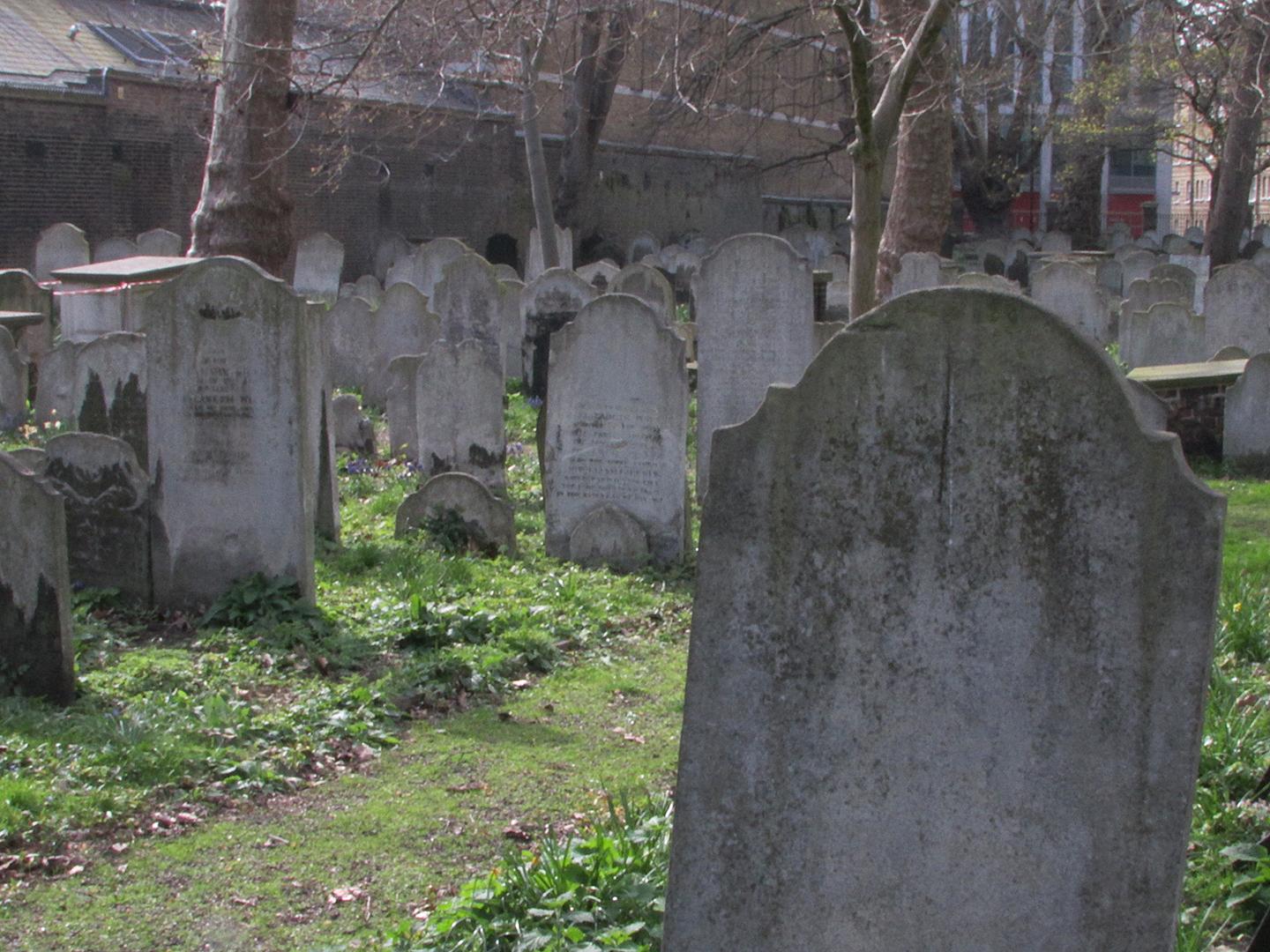
Bunhill Fields Burial Ground in London presents a typical post-medieval graveyard with upright headstones
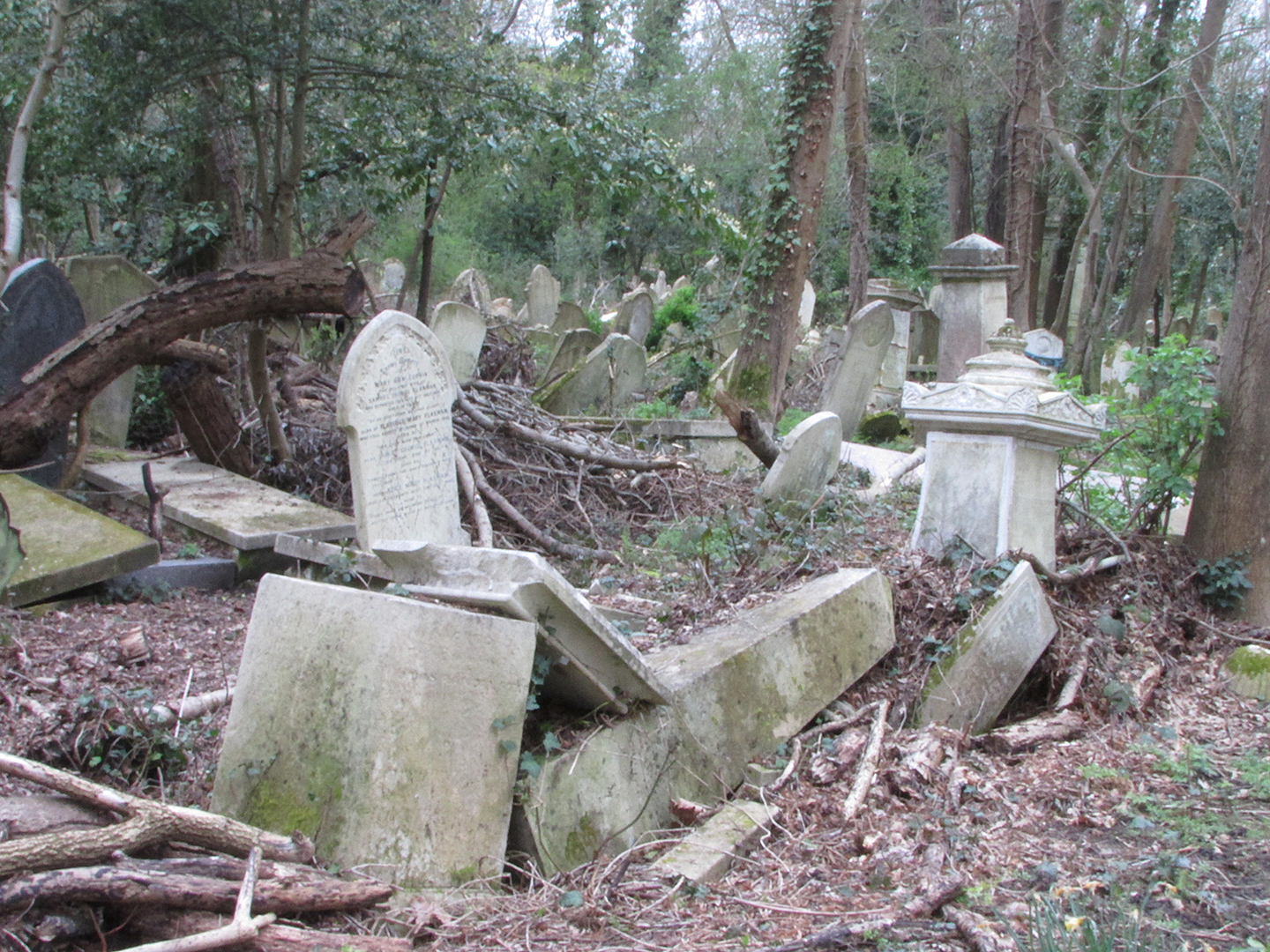
Nunhead Cemetery in London contains several monument styles in varying states of dilapidation
Readings
-
For more information about funerary history that informs much of the work described throughout this website, please consult the following sources:
• Graveyards: A History of Living with the Dead by Roger Luckhurst
• Traditions of Death and Burial by Helen Frisby
• Corpses, Coffins, and Crypts: A History of Burial by Penny Colman
• Necropolis: London and its Dead by Catherine Arnold
• Graveyard Gothic by Eric Parisot, David McAllister, and Xavier Aldana Reyes
• The Archaeology of Death and Burial by Mike Parker Pearson