TIGER ROAD
| Tiger Road | |
|---|---|
| Game Information |
| Country of Origin | Japan |
| Original Title | 虎への道 (Torahenomichi) | Translated Title | The Way of a Tiger |
| Development Information | |
| Developer | Capcom |
| Publisher | Romstar |
| Designer | Tokuro Fujiwara |
| Release Information | |
| Release Dates |
|

The jiangshi (僵尸) — known as kyonshi (殭屍 or キョンシー) in Japanese, cung-thi (殭屍) in Korean, and hangui (강시) or hanja (殭屍) in Korean — is a distinctive figure in Chinese mythology that has entered Western culture via two avenues: kung-fu cinema (particularly the Mr. Vampire comedy-horror movies distributed by Golden Harvest in the 1980s) and video games. This series assesses several noteworthy appearances of the jiangshi in video games that were ported to the United States primarily through Japanese game developers, thus earning the name Kyonshi Kount.
One of the most faithful representations of the kyonshi appears in Tiger Road, an arcade game released in 1987. In the game, players control Lee Wong, a martial artist who closely resembles Shaolin monks, in his quest to rescue the children who were abducted from the Oh-Lin Temple by agents of the Dragon God called the Four Devas. Lee Wong traverses five stages in order to defeat each of the Four Devas before confronting the Dragon God himself. Tiger Road is rich with classic Chinese aesthetics that are adapted through the cultural lens of Japan, thus transforming a consistent intercultural exchange that characterizes much of Japanese aesthetics through the context of video games. Curiously, few of these aesthetics were altered for Western, English-speaking audiences, leaving the kyonshi relatively intact when it appears in stage two.
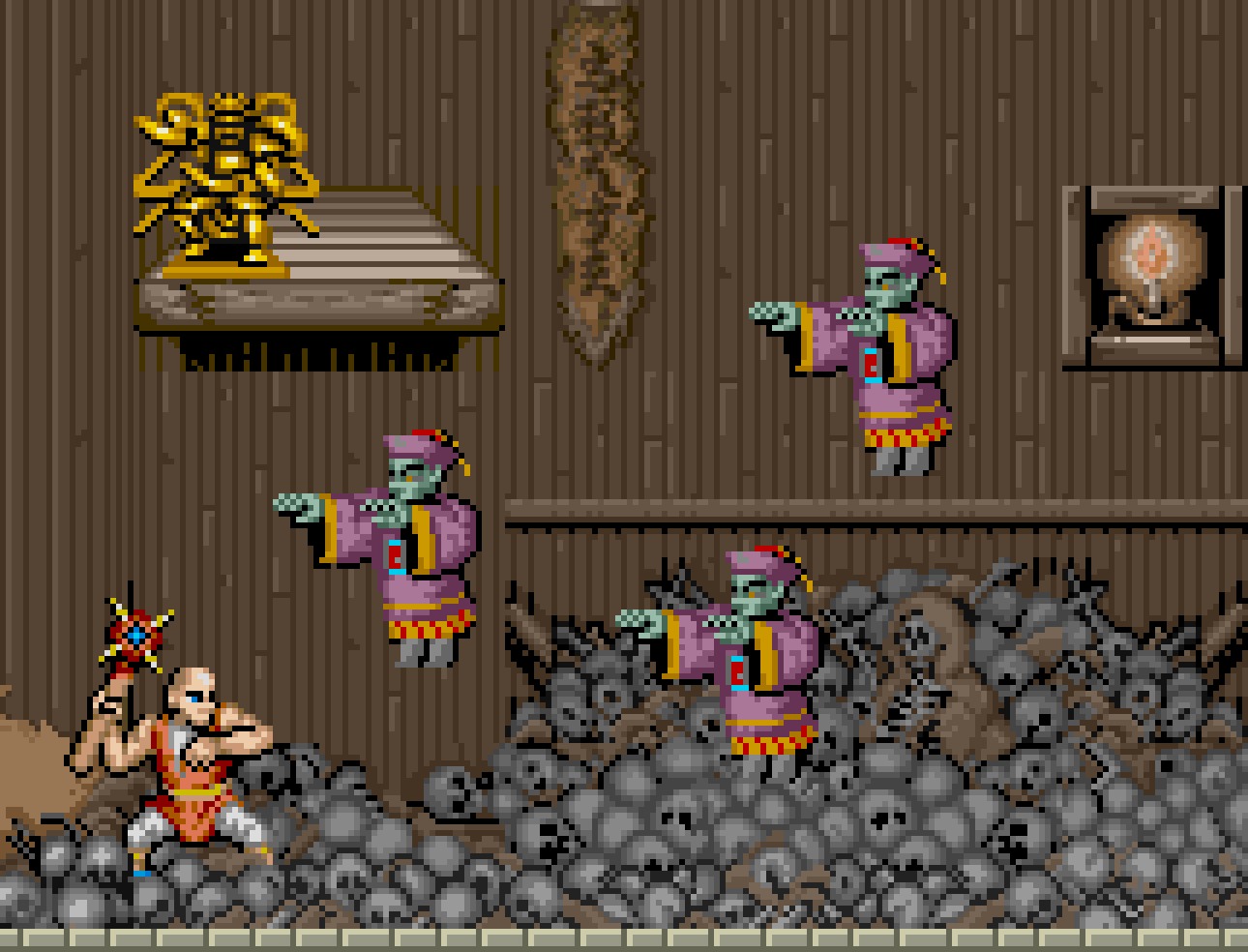
Several kyonshi appear in the second stage of Tiger Road, a horror-themed stage featuring several instant-death threats and a host of lethal creatures.
While the first stage of Tiger Road is a straightforward charge through the countrysides and battlements of a fictionalized Ancient China, the second stage immediately casts a dour cloud over Lee Wong's adventure. Burdened by a crimson sky, Lee Wong enters a decrepit tower filled with snakes, human bones, giant spiders, vampire bats, and death-traps that are both practical and supernatural, all of which are governed by the Kukai, the second of the Four Devas. Thus the second stage endows Tiger Road with a horror theme that exists somewhere inbetween Chinese and Western aesthetics. Once Lee Wong ascends to the third story of Kukai's tower, he finds himself in a room littered with skeletal remains from which hopping kyonshi emerge to attack him. Bearing all of the familiar elements of the traditional kyonshi with the exception of the ofuda amulet that keeps the corpses from re-animating, the enemies lunge towards Lee Wong somewhat mindlessly, which emphasizes their nature as little more than human corpses that thirst for life essence. Similarly, enormous human skulls appear throughout the same area that attempt to devour Lee Wong, resulting in instant death when he is sucked into their mouth and chewed up. Moreover, Kukai himself is an undead being that feasts upon the living, inflicting another form of instant death by latching into Lee Wong and draining his life in one motion. Essentially, Kukai's tower is anathema to human life, which is indicated not only by its sinister occupants but also by the fact that no human enemies are found after Lee Wong ascends to the second floor of the tower. As perhaps one of China's most easily recognizable undead monsters, the kyonshi enforces the horror theme of Tiger Road's second stage much in the same way that the presence of a zombie or vampire would bolster associations with horror in a Western European perspective.

The manual for Tiger Road's port on the TurboGrafx-16 refers to the kyonshi enemy as Zombie Man.