KYONSHI KOUNT #1: SUPER MARIO LAND
| Super Mario Land | |
|---|---|
| Game Information |
| Country of Origin | Japan |
| Original Title | スーパーマリオランド (Sūpāmariorando) | Translated Title | Super Mario Land |
| Development Information | |
| Developer | Nintendo R&D1 |
| Director | Satoru Okada |
| Producer | Gunpei Yokoi |
| Artist | Hirofumi Matsuoka Masahiko Mashimo |
| Release Information | |
| Release Dates |
|

One of the most recognizable undead creatures from Southeastern Asia is the Chinese jiangshi (僵尸), a sentient hopping corpse that drains the life essence from the living. According to Chinese folklore, the jiangshi was inspired by a Quing Dynasty (1644–1912) practice called "corpse-driving," where the bodies of dead laborers were transported from one province to another by means of being stood upright and placing their arms outstretched in front of them so that they can be tied to long bamboo sticks. Several corpses would be trussed to bamboo sticks and carried along their journey by two corpse-drivers, with one person holding the bamboo trusses at the front of the dead procession while the other holds the back-end. Walking some thousands of miles from the site of their death to their home village, the movements of the corpse-drivers would cause the bamboo to wobble up and down, thus making it seem as though the corpses are hopping as the dead procession moves along. Alternatively known as a hopping vampire or hopping zombie, they shared a common appearance coinciding with the funerary attire of the era, which consisted of a long black robe typically emboirdered with an ornate design chest, a round rimmed hat resembling that of a court official, and — most importantly — a thin paper talisman covered in a sealing prayer that, when affixed to the jianhshi's forehead, renders it immobile. This talisman, known as a fulu (符箓), is what prevents the jiangshi from reanimating. When the fulu is removed, the jiangshi regains sentience and assails the living.
Long after its appearance in the imagation of the Quing Dynasty, the jiangshi was popularized by a series of Chinese films that merged kung-fu with comedy and horror, the first of which, Mr. Vampire, spawned several sequels and established the jiangshi as a recurring monster that became popular first throughout Southeastern Asia before arriving almost intact in the United States. In Vietnam it is known as cuong-thi (殭屍), in the Koreas as the hangui (강시) or hanja (殭屍), and in Japan as the kyonshi (殭屍 or キョンシー) However, I posit that more people were introduced to the jiangshi through video games before the films found a firm enough foothold in the cultural underground of the United States. I can confirm, anecdotally, that I saw the jiangshi in video games decades before movies like Mr. Vampire and Close Encounters of the Spooky Kind were made available to me. Although entirely subjective, the jiangshi's entrance into underground culture via film and video games would establish its familiarity among gaming enthusiasts, evinced by a consistent presence in video games and table-top role playing games that occur with such frequency in Western audiences that they grew to outnumber their cinematic predecessors. Owing to my own experience with this distinctive Southeastern Asian form of hopping undead by means of video games developed in Japan, which also fits into the scope of IconoGrave, this will be the first of a series called Kyonshi Kount that examines the appearances of kyonshi in video games that have reached Western audiences.

A kyonshi named Pionpi appears in the instruction manual for Super Mario Land for the Nintendo Gameboy
An early kyonshi appearance occurs in Super Mario Land for the Nintendo Gameboy in 1989. Oddly, Super Marios Bros. is a series that rarely features undead creatures, nevermind those of a very identifiable Chinese origin, typically erring towards shy ghosts and the rare reference to slasher films of the 1980s in the sequel to this game, Super Mario Land II: Six Golden Coins. The kyonshi's appearance still errs towards the cute and/or cuddly, despite the mortal threat it imposes to Mario, but also appears in a context that reinforces the kyonshi's Chinese heritage. Upon reaching world 4-1, which is the first level in the final world of the game, the player is greeted with a distinctly Chinese melody playing against a backdrop of tall bamboo shoots and distant mountaintops peering from a distant fog implied by a formless expanse of grey/green that forms the background. The kyonshi quickly makes an appearance, approaching Mario with premeditated jumps and damaging him upon contact. With as much detail as the original Gameboy can muster, this kyonshi — called Pionpi in the instruction manual — retains its outstretched arms, long dark garment, distinctive hat, and has a long ponytail emerging from the back of its hat. Clearly Pionpi is a jiangshi, but the question remains: "how many gamers in 1989 knew what a jiangshi was?" Pionpi's sole apperance in Super Mario Land, never seen before or thereafter, proves the question salient, as it would be unfamiliar even in the context in which it appears.
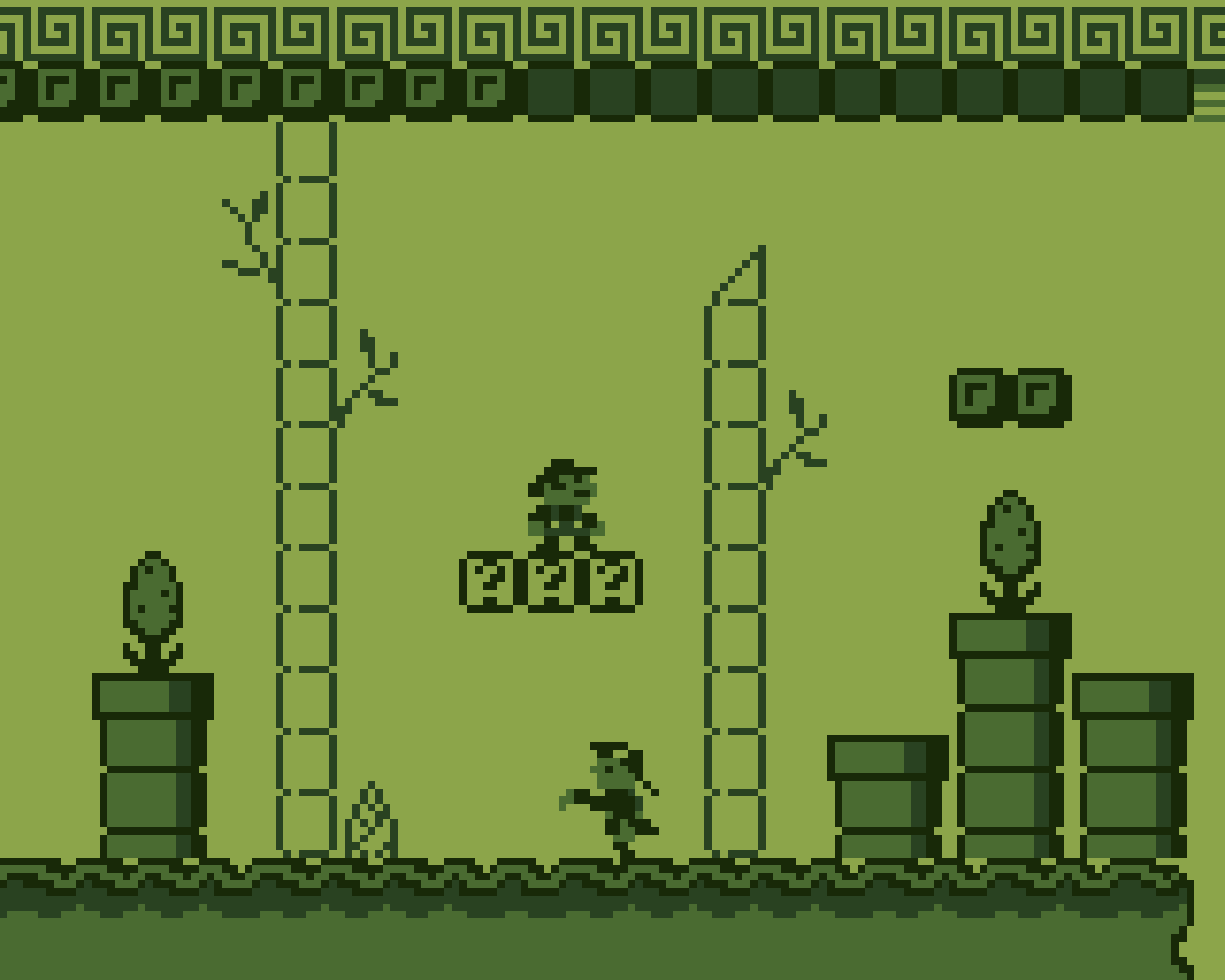
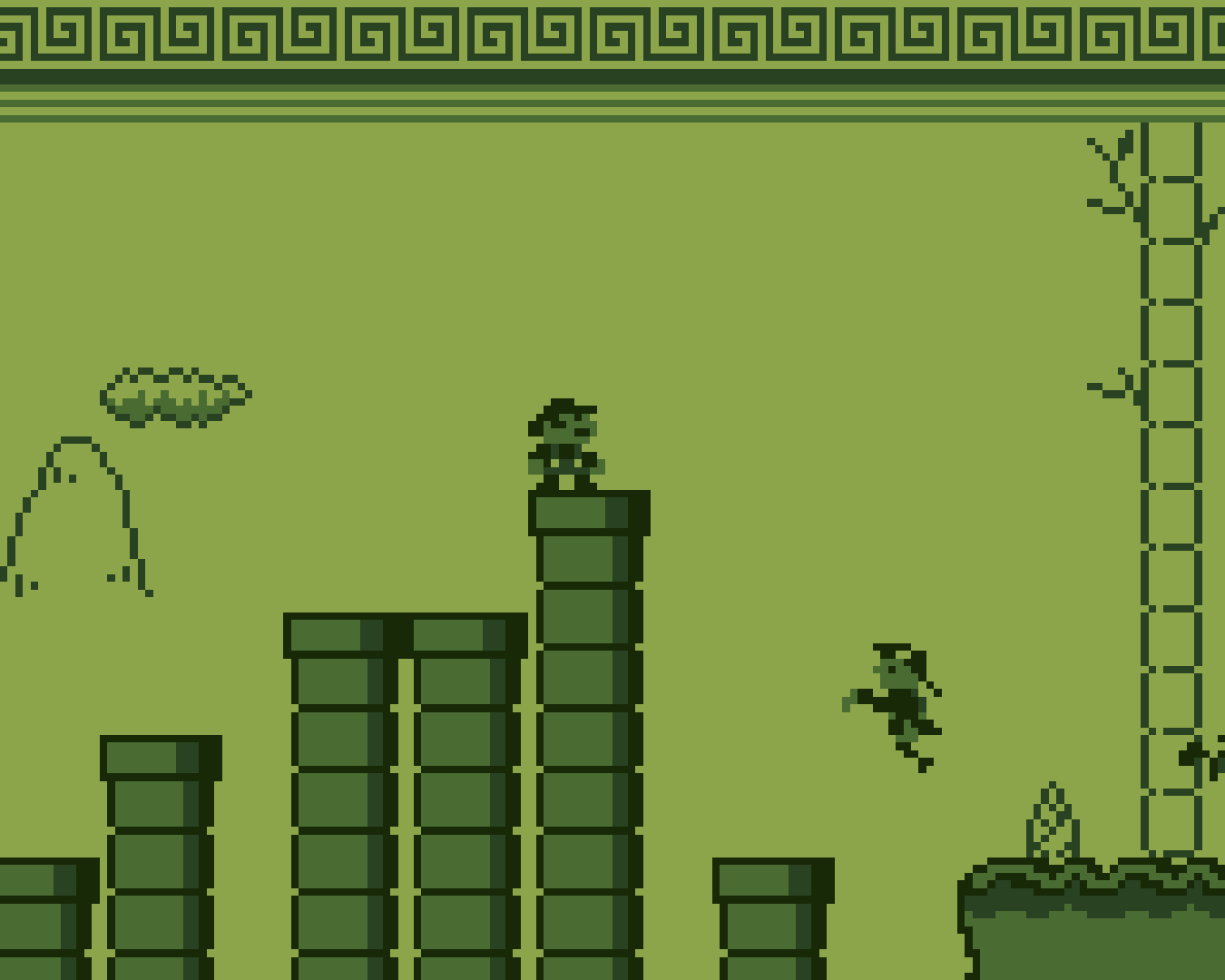
Pionpi appears against a backdrop of Chinese aesthetics in world 4-1
At first glance, Pionpi's jumping attack is far from unique considering that most of the enemies in Super Mario Land leap towards Mario in an upward arc. Mario's go-to form of defense, jumping on enemies, proves risky throughout this game, as many of the enemies have a last-ditch attack that occurs shortly after they are slain under Mario's feet. Similarly, Mario's odd geometrical bullet attack, the superball, will permanently kill most enemies and thus bypass the threat of their dying throes. Pionpi, however, cannot be slain by being jumped upon, and is only temporarily stunned before assailing Mario once more. The only way to deal with Pionpi is to flee by scrolling it offscreen, allow it to leap into a pit, or by striking them with two superballs. This not only increases the enemy difficulty for the late game experience, but also lends a semblance of immortality to Pionpi in that it cannot easily be slain. The rarity of Mario's superball power-up, as well as the ease with which Mario can lose it, make Pionpi even more threatening while bolstering its nature as an undead entity to whom death has no effect.
Although Pionpi's tenure in the world of Super Mario Bros. was short-lived compared to its own in-game immortality, it would prove influential in developing gameplay mechanics for another undead creature in the series, Dry Bones. Introduced in Super Mario Bros. 3 when the game was first released in Japan in October 1989, Dry Bones is a skeletonized koopa (an enemy resembling a turtle) found in fortresses and subterannean areas. Whereas koopas are easily defeated by jumping on top of their shell, Dry Bones follows Pionpi's suit and merely disarticulates into a pile of bones momentarily. After a few seconds, Dry Bones reassembles and continues to pose a threat to Mario. Released in Japan in April 1989, Super Mario Land predates Dry Bones' appearance in Super Mario Bros. 3, and may have been inspired by Pionpi's implied undead immortality. The main difference is thematic, since Pionpi's obvious nature as a jiangshi from Chinese folklore does not readily integrate into the world of Super Mario Bros., which relies on exceedingly few outside influences and instead opts more often than not to create its own unique character and enemy designs.