
Morgue from the opening scene





| Shadowrun | |
|---|---|
| Game Information |
| Country of Origin | Australia |
| Development Information | |
| Developer | Beam Software |
| Producer | Koichi Ota Adam Lancman |
| Designer | Pauli Kidd Greg Barnett Arthur Kakouis |
| Artist | Holger Leibnitz Mark Maynard |
| Release Information | |
| Release Dates |
|
GAME INFO: Shadowrun is an isometric, top-down adventure game with role-playing elements using concepts and gameplay mechanics from the cyberpunk table-top role-playing-game series of the same name. Players control the amnesiac Jake Armitage in his quest to regain his memories and unravel the details of an attempt to assassinate him that proved a failure. Jake collects clues by interacting with people and objects, dodging a constant barrage of hitmen, entering an internet-like system of information called The Matrix, and engaging with supernatural spirits.
SETTING: The game takes place in a futuristic version of Seattle, Washington in the year 2050, after an event took place where magic re-entered the world and created several subspecies of homo sapien that resemble elves, dwarves, orcs, and trolls. Technology and humanity also merge, allowing people to integrate electronic hardware into their body, some of which allows them to enter digital spaces with physical verisimilitude while others enhance their reflexes or stamina to superhuman capacities. Jake navigates through several parts of Seattle and Bremerton, wandering through streets and alleyways, night clubs, huge corporate buildings, cemeteries, a ruined ship, and a vampire-haunted mansion.
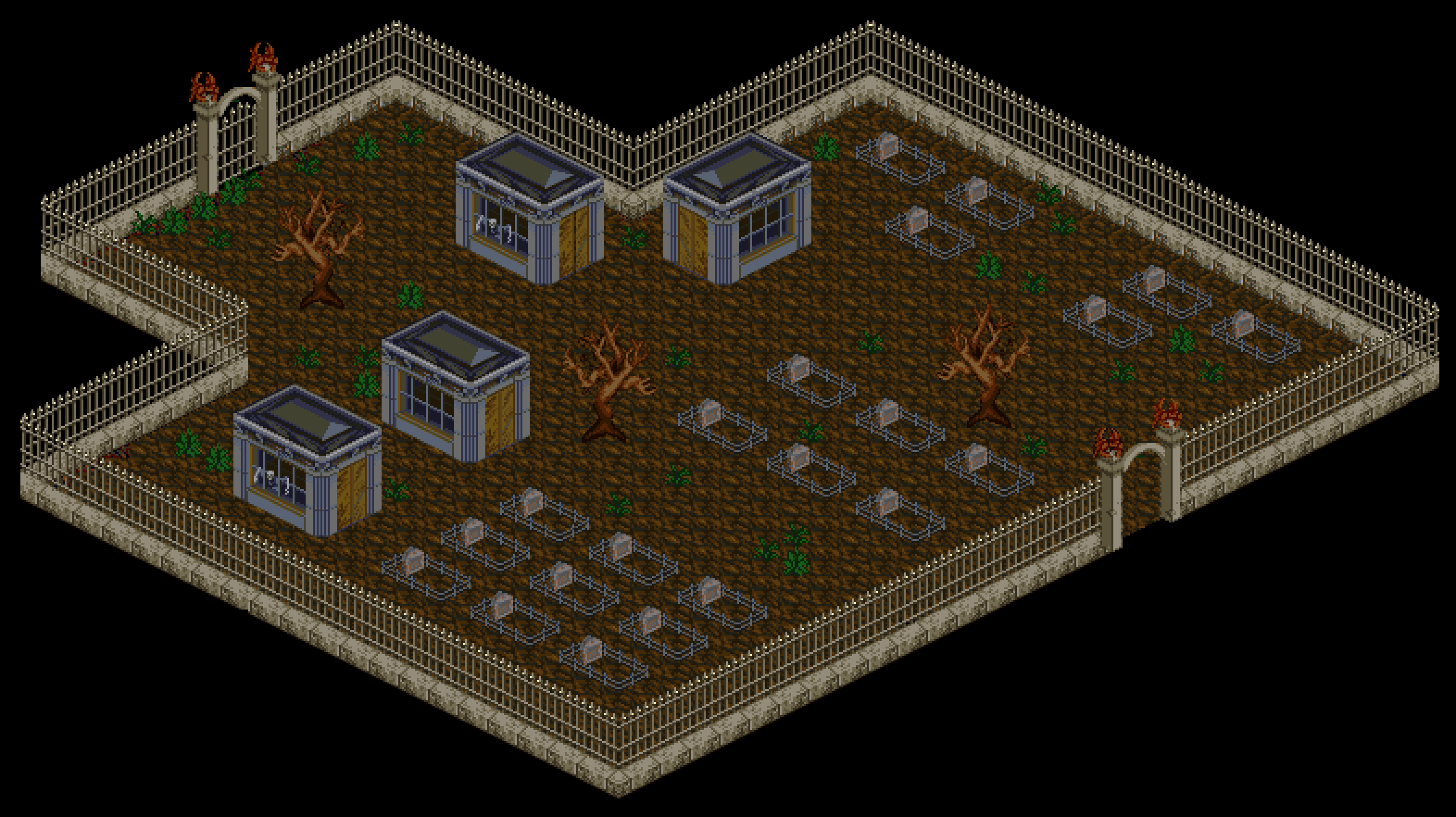
FUNERARY IMAGERY: The game's opening takes place in a morgue, where two morticians shut Jake away into a vault unaware that he is still alive. Two cemeteries are present in the overworld map of Shadowrun, one being a larger cemetery on Tenth Street with numerous headstones and four above ground crypts, while another much smaller cemetery with only a few headstones forms the entrance to the Seattle sewer system where a rat-worshipping shaman dwells. The headstones are similar to those found in twentieth-century cemeteries, being upright, capsule shaped stones on small plots surrounded by metal fencing. The crypts have a faint resemblance to art-deco designs, characterized by striated marbly columns, a gated windows, golden doors, and a raised, pyramidal roof. Crypts that are left-facing from the camera's perspective reveal a skeletal corpse dangling from the window's gates. These crypts, when pried open with a sharp object, reveal several black coffins that occasionally contain money. The basement of mansion occupied by the vampiric Dark Blade Club contains three floors of catacombs filled with coffins, which leads to the lair of a vampire.
ANALYSIS: Shadowrun displays a certain sense of gallows humour by beginning in a mortuary setting, where the two morticians are so afraid of Jake that they lock themselves in an adjacent room until he returns wearing sunglasses, which is suitable enough to convince them that he is an altogether different person. However, as players discover upon entering the Tenth Street cemetery for the first time, the morticians have good reason to be afraid of an animated corpse. Cemeteries in the world of Shadowrun are populated by ghouls, which are humans infected with the Human Meta-Human Vampiric Virus III, a virus that exhibits different vampiric tendencies depending on which subspecies of homo sapiens is infected. Infected humans become corpse-like, lose their eyesight, become allergic to sunlight, and must consume raw human flesh to survive. Generally, ghouls become feral after infection, but some attempt to maintain a semblance of civilization beyond ordinary society. In this game, all ghouls the players encounter are feral, and they continually emerge from cemetery grounds or in catacombs. The presence of ghouls, along with the game's sole vampire Vladimir, provide an unanticipated Gothic flair within the otherwise cyberpunk setting, and the cemetery proves an especially familiar environment for seemingly undead humans who crave raw flesh. Since the game is a fictionalized version of Seattle, its incorporation of what appear to be twentieth-century headstones reflects one of the themes of the Shadowrun series that reflects certain shared anxieties that manifested in the United States in the very late 1980s and early 1990s, primarily the increasing reliance on technology as well as the potential for Japan to establish themselves as a global superpower, which is demonstrated in Shadowrun by the dominant currency being called nuyen, a take on the Japanese yen. In some ways, the Human Meta-Human Vampiric Virus may be an exaggeration of the Human Immunideficiency Virus since, at the time, it had the effect of distancing those who were infected with the virus from society, and was tantamount to not only a literal death sentence but also a social one. Later games in the series and some novels and table-top modules would portray ghouls in more sympathetic light, closer allegorizing the plight of humanity living in a post-HIV world, but in this game the ghouls present a universal threat in their natural habitat of the cemetery.