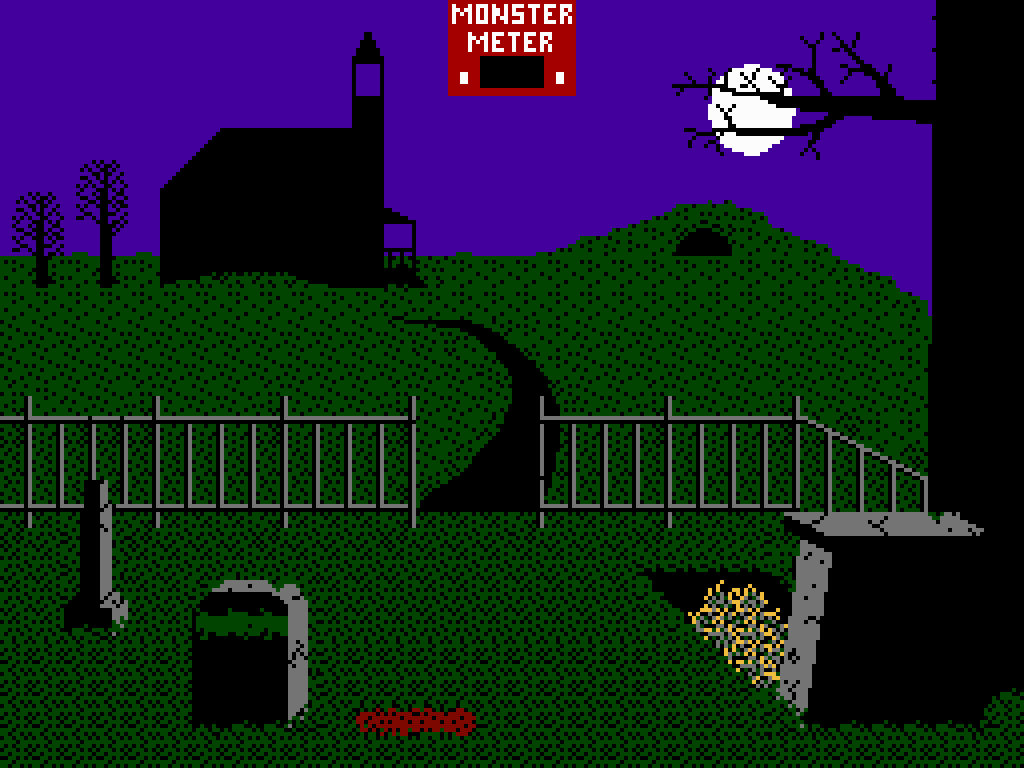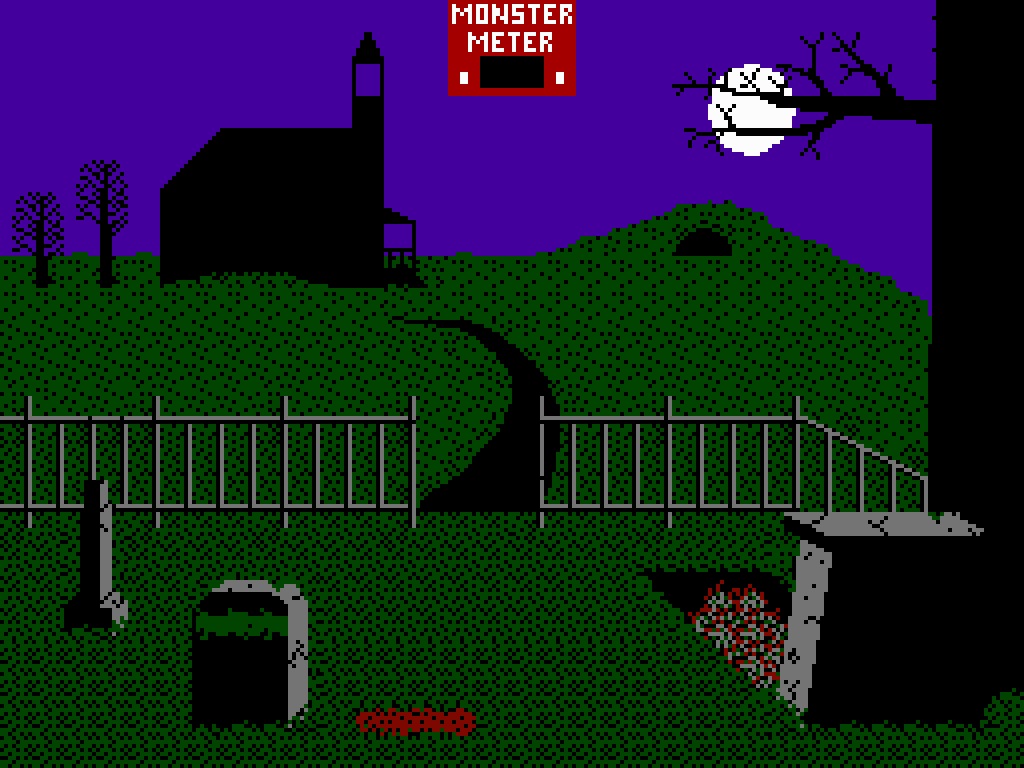

The graveyard appears as the final level in the arcade version





| Chiller | |
|---|---|
| Game Information |
| Country of Origin | United States |
| Development Information | |
| Developer | Exidy |
| Director | Richard Frick | Artist | John Dunn Jonathan Watson |
| Release Information | |
| Platforms |
N. AMERICA: Nintendo Entertainment System (1990) |
GAME INFO: Chiller is a controversial shooting game that was noteworthy for its depictions of violence and brief female nudity. Players score points by shooting various people, objects, and creatures in three static, horror-themed shooting galleries. Most, if not all, of the humans depicted in Chiller are captive, typically held in torture devices or chained to walls, and as such are open to being attacked by creatures that wander onscreen as well as by players themselves, who are awarded points for shooting specific body parts or sections of the contraptions that contain them, which enact executions that were particularly grisly during the era of the late 1980s.
SETTING: Despite the game's distinctly shooting gallery style, which is reinforced by arcade cabinets mounted with a gun-shaped controller, Chiller takes place in a fantasy version of the Middle Ages when the dead begin to reanimate and plague the living. Players take up the charge of defeating the hordes of undead using a magic wand that behaves very similarly to a gun, and wander through four levels: a torture chamber, a basement leading into a sewer, a hallway resembling catacombs, and a graveyard.
FUNERARY IMAGERY: The graveyard level, which is the final level in the arcade version of Chiller and the first level in its Nintendo port, contains two headstones and a small obelisk within a wrougt-iron fence. A larger headstone on the right side of the screen is still open, and supernatural flames flicker inside of its opening. Regularly, a human arm will emerge from the soil besides the headstone on the left side of the screen and lob severed heads into the open grave on the right side. On the horizon, a church is seen in silhouette with stained glass windows flashing on occasion.
ANALYSIS: Chiller is a strange representation of the video game graveyard in that it very closely resembles graveyards from the eighteenth and ninteenth century that are most often found on church grounds, with familiar upright headstones and the uncommon appearance of an obelisk, all of which are enclosed by a traditional wrought-iron fence. Furthermore, all of the funerary architecture appears to be somewhat worn in its pixellated rendering, keeping with representations of graveyards in horror films. However, Chiller's historical context is murky at its best and immaterial at its worst. Players are not provided with any narrative context when playing the game unless they have access to the game manual that was packaged with its Nintendo Entertainment System port, wherein the developers briefly mention that the game takes place in the Middle Ages and that the people being shot are, in fact, undead and not the perfectly normal people they appear to be. However, no medieval signifiers appear in the game whatsoever, which has post-medieval technology such as a guillotine, which was invented during the French Revolution in the late eighteenth century, and a half-inhumed woman wearing a t-shirt in the graveyard level. The tombstones themselves are also anachronistic, closer resembling modern headstones than anything that would have survived from the medieval Europe. Essentially, Chiller attempts to have its cake and eat it too by representing human beings — frequently disrobed — in varying states of helplessness whose torture and demise at the hands of the player's gun-like "magic wand" becomes a mandatory objective that is required to progress through each level. Anachronism is not an inherent sign of poor narration, as sometimes it manifests through aberrant interpretations of Western imagery by Japanese game designers who do not have access to the knowledge that medieval graveyards did not resemble modern ones (Ghosts 'n Goblins is the quintessential example of this phenomenon). Also, anachronistic aesthetics are a key element of Gothic literature that appeared — and persisted — since the genre's birth via The Castle of Otranto written by Horace Walpole in 1762, and is expected to reveal itself to a degree in horror themed aesthetics. In the case of Chiller, it is difficult to discern whether the game's anachronistic elements are examples of how anachronistic imagery manifests in Gothic horror or if the narrative of an undead plague in the Middle Ages was tacked on in order to justify what otherwise appears to be killing people for sport.